
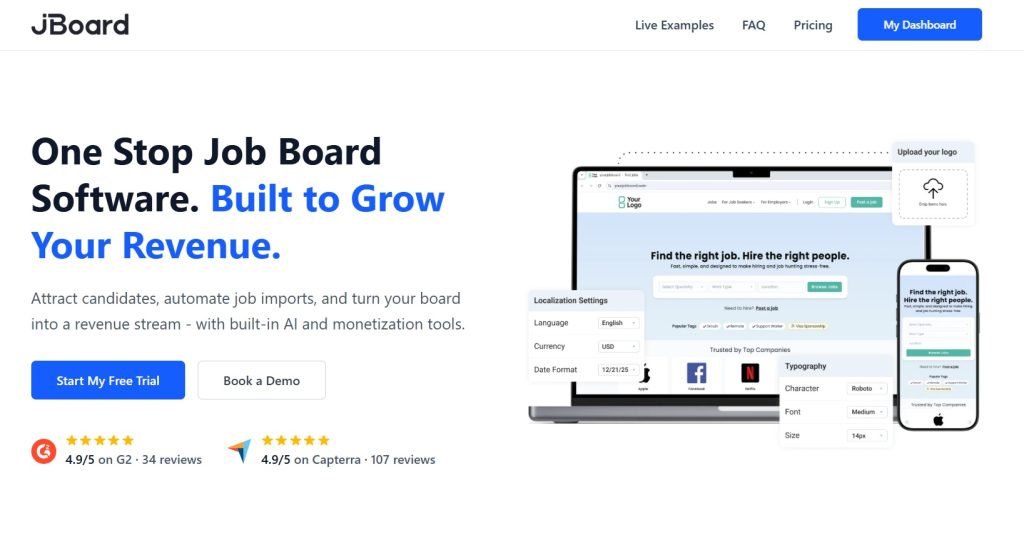
Starting a job board website used to mean hiring developers, building complicated recruitment systems, and spending months preparing a platform before the first employer could publish a vacancy.
That is no longer the case.
Today, entrepreneurs, professional associations, recruitment agencies, and online communities can launch specialized job boards without writing code or maintaining custom software.
But creating a job board is only the beginning.
The real challenge is building a platform that attracts relevant candidates, earns employers’ trust, and generates sustainable revenue.
In this guide, you’ll learn how to start a job board website in 2026, choose a profitable niche, attract employers and job seekers, automate job listings, and build multiple income streams.
You’ll also discover how modern job board software such as JBoard simplifies the technical work, allowing you to focus on growing your business.
1. Why Starting a Niche Job Board Is Still a Business Opportunity
The online recruitment industry is competitive, but that does not mean every opportunity has been taken.
Large employment platforms serve millions of users across countless industries. Their broad reach is valuable, but it also creates opportunities for specialized platforms.
Consider a healthcare employer looking specifically for experienced oncology nurses.
A general employment website might deliver hundreds of applications, many from candidates who lack the required qualifications.
A specialized healthcare job board can provide a more focused recruitment experience.
The same principle applies to industries such as:
- Renewable energy and sustainability
- Cybersecurity and information technology
- Remote accounting and finance
- Healthcare and specialized nursing
- Aviation and aerospace
- Skilled trades and manufacturing
- Military veterans and transitioning service members
- Education and academic research
A successful niche job board does not necessarily need millions of visitors.
It needs the right audience.
The business opportunity lies in connecting employers with qualified candidates more efficiently than a general-purpose platform can.
When a job board consistently attracts relevant professionals, employers have a stronger reason to pay for visibility and recruitment services.
2. Choose a Job Board Niche With Real Hiring Demand
One of the most important decisions you’ll make is choosing your market.
A common mistake is launching a general job board and attempting to compete directly with established recruitment platforms.
A more practical strategy is to begin with a clearly defined audience.
Look for industries with recurring recruitment needs
Industries that hire regularly can create opportunities for repeat business.
For example, a specialized job board serving healthcare organizations might attract hospitals, clinics, staffing companies, and private medical practices.
Instead of relying entirely on one-time job advertisements, the platform could eventually offer recurring employer subscriptions.
Evaluate the competition
Competition is not automatically a bad sign.
Existing recruitment platforms may indicate that employers already spend money to reach candidates in your chosen market.
Research competing websites and ask:
- Are their job listings relevant and current?
- Do they provide a good mobile experience?
- Are their employer packages affordable?
- Do they focus on a specific professional community?
- What important features or audiences are underserved?
Your objective is not necessarily to invent an entirely new recruitment category.
It is to identify an existing hiring problem that you can solve more effectively.
Validate your idea before investing heavily
Before launching, speak with potential employers and candidates.
Ask employers where they currently advertise positions, what they pay for recruitment, and what frustrates them about existing platforms.
Ask candidates which websites they use, how they discover opportunities, and what would make a specialized job board useful.
These conversations can reveal whether your proposed niche has genuine commercial potential.
3. Choose the Right Job Board Software
Once you’ve selected your niche, the next decision is how to build the platform.
There are three common approaches.
Option A: Build custom job board software
Custom development provides extensive flexibility, but it also introduces technical responsibilities.
You’ll need to manage website development, hosting, security, employer accounts, payment processing, application workflows, and ongoing maintenance.
This approach may be appropriate for organizations with highly specialized requirements and dedicated technical resources.
However, it can be unnecessarily expensive for entrepreneurs validating a new job board concept.
Option B: Use a general website builder
A traditional website builder can help create attractive pages, but recruitment platforms require functionality beyond ordinary websites.
Employers need to publish vacancies, manage applications, and purchase recruitment services.
Candidates need searchable listings, relevant filters, job alerts, and application tools.
Implementing these capabilities through multiple third-party extensions can increase operational complexity.
Option C: Use dedicated white-label job board software
For many founders, dedicated job board software provides a more straightforward starting point.
A white-label platform lets you operate a recruitment website under your own brand without developing the underlying recruitment infrastructure.
For example, JBoard provides an integrated platform for building, managing, and monetizing job boards.
Its capabilities include:
- A drag-and-drop website builder
- Custom domain support
- Employer dashboards
- AI-powered job imports
- Candidate profiles and resume databases
- Applicant tracking and messaging
- Paid job postings and employer subscriptions
- Job alerts and SEO tools
- Stripe payment integration
- Analytics and reporting
Rather than coordinating multiple software systems, you can manage core job board operations from one platform.
This makes dedicated software particularly useful for founders who want to validate a market before committing to extensive custom development.
4. Create a Professional Job Board That Reflects Your Brand
Your job board should look like a trusted recruitment destination, not a generic collection of job advertisements.
Branding influences how employers and candidates perceive your platform.
A professional website should communicate three things immediately:
Who the platform serves, what opportunities it provides, and why visitors should use it.
Build a clear homepage
Your homepage should feature a prominent job search function, a short explanation of your niche, and straightforward navigation.
For example, a cybersecurity recruitment website could use the headline:
“Discover Cybersecurity Careers With Companies That Value Your Expertise.”
Supporting content could highlight popular job categories, featured employers, and recently published opportunities.
Make the candidate experience simple
Job seekers should be able to find relevant positions without unnecessary obstacles.
Useful functionality includes:
- Search by job title or keyword
- Location and remote-work filters
- Employment type and category filters
- Clear job descriptions
- Mobile-friendly application experiences
- Email alerts for new opportunities
A complicated search experience can discourage candidates from returning.
Give employers a professional experience
Employers should also have a straightforward process for creating accounts, posting vacancies, and managing applications.
JBoard includes employer dashboards and applicant tracking functionality, helping businesses manage recruitment activity directly through the job board.
Its website builder also supports custom domains and design customization, allowing operators to establish a distinct brand without custom coding.
5. Solve the Empty Job Board Problem With AI Job Backfill
One of the biggest obstacles for new job boards is the marketplace problem.
Candidates want to visit websites with plenty of relevant opportunities.
Employers want to advertise on platforms that already attract candidates.
But how do you attract either group when your job board is brand new?
This is where automated job backfill can help.
What is job backfill?
Job backfill is the process of importing relevant vacancies from external sources into your job board.
Instead of manually creating every listing, you can populate the website with existing opportunities that match your audience.
For example, a renewable energy job board might display positions for solar engineers, wind turbine technicians, environmental consultants, and sustainability managers.
The imported listings give candidates a reason to explore the platform before you’ve established a large base of direct-paying employers.
How JBoard’s AI Job Backfill works
JBoard offers AI-powered job backfill designed to help new and established job boards maintain relevant listings.
According to JBoard, its system searches more than 200,000 career sites and imports matching opportunities daily.
Operators can define criteria such as:
- Industry
- Job title
- Location
- Keywords
- Other niche-specific requirements
The platform also includes controls for detecting duplicate and low-quality listings.
This can significantly reduce the manual effort involved in maintaining a useful job database.
However, imported jobs should support your growth strategy rather than replace it entirely.
The long-term objective is to attract employers who recognize your audience’s value and publish vacancies directly on your platform.
Automated backfill helps create the initial candidate experience while you work toward that goal.
6. Build Multiple Revenue Streams From Your Job Board
A job board becomes a business when employers or partners are willing to pay for the value it delivers.
Fortunately, job boards are not limited to charging for individual job advertisements.
Modern recruitment platforms can support several monetization models.
Revenue Model 1: Paid job postings
This is one of the simplest ways to monetize a job board.
Employers pay a fixed amount to publish a vacancy for a specified period.
For illustration, you might offer:
| Package | Example Price | Included |
|---|---|---|
| Standard Listing | $49 | One job posting for 30 days |
| Featured Listing | $99 | One job posting with additional visibility |
| Hiring Bundle | $199 | Five job postings |
| Monthly Employer Plan | $149/month | Recurring posting allowance |
These are illustrative business pricing examples, not JBoard’s software subscription prices.
The right pricing depends on your industry, traffic quality, employer demand, and competitive landscape.
Revenue Model 2: Employer subscriptions
Some employers hire throughout the year.
Instead of purchasing individual advertisements repeatedly, they may prefer a monthly or annual recruitment package.
Subscriptions can provide more predictable revenue for the job board operator.
JBoard supports employer packages and subscriptions, allowing operators to create offers for businesses with recurring recruitment needs.
Revenue Model 3: Featured jobs and promotional upgrades
Employers may pay extra to make important vacancies more visible.
Potential upgrades include featured listings, pinned jobs, and enhanced employer visibility.
These add-ons can increase revenue without requiring the acquisition of additional customers.
Revenue Model 4: Resume database access
A specialized candidate database can become valuable as your audience grows.
Employers may be willing to pay for access to searchable candidate profiles, particularly in industries where qualified talent is difficult to find.
JBoard includes resume database and resume parsing capabilities.
If you offer this service, establish appropriate candidate consent, privacy controls, and data access policies.
Revenue Model 5: Applicant tracking tools
Some employers need more than advertising space.
They also want tools for reviewing applications, communicating with candidates, and organizing recruitment activity.
JBoard includes applicant tracking and candidate messaging functionality that operators can incorporate into their commercial offerings.
Revenue Model 6: Job feeds and recruitment partnerships
Job board operators may also explore revenue through partner distribution, XML feeds, CPC arrangements, and related recruitment services.
The commercial value of these opportunities depends on your traffic, audience, and partner agreements.
A diversified revenue model can make a job board more resilient than relying exclusively on one-time job posting purchases.
7. Attract Job Seekers Through Search Engine Optimization
Building a job board is only half the equation.
You also need a reliable way to attract visitors.
Search engine optimization, or SEO, can become an important acquisition channel because job seekers frequently search for specific positions, industries, and locations.
A well-structured niche job board can target these searches through relevant listings, category pages, and educational content.
Optimize individual job listings
Each job listing should have a descriptive title and useful information.
For example:
Weak title:
“Exciting Career Opportunity”
Better title:
“Senior Cybersecurity Analyst — Remote — United States”
The second title communicates the role, working arrangement, and location.
Job descriptions should also clearly explain responsibilities, qualifications, compensation when available, and application instructions.
Create industry-specific landing pages
Category pages can help organize your website while targeting relevant search intent.
A healthcare job board might create pages for nursing jobs, medical assistant jobs, physical therapy careers, and healthcare administration positions.
Location-based pages may also be useful when they contain genuine, relevant opportunities.
Avoid generating large numbers of nearly identical pages solely to attract search traffic.
Use structured data for job listings
Google supports JobPosting structured data, which can help eligible job pages appear in its job search experience.
JBoard includes Google for Jobs integration and SEO-oriented job board functionality.
However, structured data does not guarantee visibility.
Listings must comply with Google’s requirements, remain accurate, and provide a functional application experience.
Publish helpful content
A job board blog can attract people before they are ready to apply for a specific position.
For example, a cybersecurity job board might publish:
- How to Become a Cybersecurity Analyst in 2026
- Entry-Level Cybersecurity Jobs That Don’t Require a Degree
- Cybersecurity Resume Tips for Career Changers
- Common Cybersecurity Interview Questions
- How Employers Can Hire Experienced Security Professionals
These articles serve different stages of the recruitment journey.
They can attract candidates, build credibility, and create opportunities to introduce relevant job listings.
JBoard includes a built-in blog, allowing operators to publish educational and industry-specific content alongside their recruitment listings.
8. Attract Employers Before You Have Significant Traffic
Many new job board founders focus entirely on candidate traffic.
But employer acquisition deserves equal attention.
A job board with thousands of visitors but no paying employers may struggle to become commercially sustainable.
You don’t necessarily need enormous traffic to begin approaching businesses.
You need a clear explanation of the audience you’re building and the recruitment problem you’re solving.
Start with a focused employer list
Identify businesses that regularly hire professionals in your niche.
For example, if you’re building an aviation recruitment website, potential customers might include airlines, maintenance companies, flight training organizations, and aerospace manufacturers.
Research their existing vacancies and recruitment challenges.
Offer introductory posting opportunities
Early employers may be hesitant to pay for an unproven platform.
Consider offering a limited number of complimentary or discounted listings to establish relationships and generate feedback.
The purpose is not to make your platform permanently free.
It is to demonstrate value and learn what employers need.
Develop recurring relationships
After employers begin receiving relevant applications, introduce paid packages that match their hiring frequency.
A business that recruits every month may find a subscription more convenient than purchasing individual advertisements.
Track which employers return, which listings attract applicants, and which packages generate repeat purchases.
These insights can guide future pricing decisions.
9. Automate Operations Without Losing Quality
A profitable job board should not require its owner to manually perform every routine task.
As the platform grows, repetitive work can consume time that would be better spent attracting employers and improving the candidate experience.
Automation can help manage:
- Job imports and listing updates
- Candidate job alerts
- Employer billing
- Subscription payments
- Application tracking
- Candidate communication
- Job listing moderation
- Performance reporting
JBoard combines many of these capabilities in one system.
Its Stripe integration supports online payments, while invoicing, tax calculation, and coupon functionality help manage commercial transactions.
Built-in analytics can also help operators evaluate activity across their platforms.
However, automation should complement human oversight.
Review imported listings, monitor application experiences, respond to employer concerns, and periodically test your payment and registration workflows.
The goal is to reduce unnecessary administrative work without sacrificing trust or quality.
10. How Much Money Can a Niche Job Board Make?
Revenue depends on several factors, including market demand, employer acquisition, pricing, and the quality of your candidate audience.
There is no guaranteed income level.
However, a simple scenario illustrates how recurring employer relationships can influence revenue.
Imagine a niche job board offering a $99 monthly employer subscription.
| Paying Employers | Monthly Revenue | Annualized Revenue |
|---|---|---|
| 10 | $990 | $11,880 |
| 25 | $2,475 | $29,700 |
| 50 | $4,950 | $59,400 |
| 100 | $9,900 | $118,800 |
These figures are hypothetical gross revenue calculations, assuming every employer pays for all 12 months.
They exclude software costs, payment processing, marketing, taxes, refunds, churn, and other operating expenses.
The purpose of the example is to illustrate the economics of recurring subscriptions, not to predict results.
Even a relatively small employer customer base could support a meaningful business if acquisition costs and operating expenses remain manageable.
Additional revenue from featured listings, job posting bundles, and recruitment services could supplement subscriptions.
11. A Practical 30-Day Job Board Launch Plan
You don’t need to build every possible feature before launching.
A focused initial release can help validate your idea while limiting unnecessary expenses.
Week 1: Research and positioning
Choose your niche and define your target audience.
Interview potential employers, evaluate competitors, and identify the core problem your platform will solve.
Decide what makes your job board different.
Week 2: Build your job board
Choose your platform, configure your domain, and customize the design.
Create essential pages, including your homepage, job search, employer information, pricing, contact details, and privacy policy.
Configure relevant job categories and candidate features.
If using JBoard, you can use its no-code builder and optional AI job backfill to prepare the initial experience.
Week 3: Add jobs and create content
Populate the platform with relevant opportunities.
Review imported listings for accuracy and quality.
Publish useful industry content and optimize important pages for search engines.
Test the candidate registration, search, and application experiences.
Week 4: Begin employer outreach
Contact potential employer customers.
Introduce your platform, explain its niche focus, and offer an appropriate introductory package.
Collect feedback from employers and candidates.
Monitor early performance and identify improvements.
At the end of 30 days, success does not necessarily mean achieving substantial revenue.
A more realistic objective is launching a functioning platform, validating audience interest, and beginning meaningful employer conversations.
12. Why JBoard Is Worth Considering for a New Job Board
Building a job board business involves several interconnected systems.
You need a professional website, a reliable source of job listings, candidate management tools, employer accounts, payment processing, and a strategy for attracting visitors.
Developing and maintaining all these components independently can be demanding.
JBoard is designed to bring these capabilities together.
Its white-label website builder allows operators to create a branded recruitment platform without custom development.
AI Job Backfill helps address the challenge of launching with an empty job database.
Employer dashboards, applicant tracking, and candidate messaging support recruitment workflows.
Monetization features allow operators to sell job postings, subscriptions, promotional upgrades, and other recruitment services.
SEO functionality, job alerts, and a built-in blog provide tools for developing a long-term audience.
JBoard reports that its software is trusted by more than 500 organizations and job boards worldwide.
For entrepreneurs, associations, recruitment agencies, and niche publishers, this integrated approach can make launching and operating a job board more manageable.
It is still important to evaluate the platform’s current pricing, plan limits, and available integrations against your business requirements.
No software can guarantee that employers will purchase listings or that candidates will visit your website.
Those outcomes depend on your market, positioning, marketing, and execution.
But choosing software that handles essential technical functions can allow you to dedicate more time to those commercial priorities.
13. Frequently Asked Questions About Starting a Job Board
Can I start a job board without coding?
Yes. Dedicated white-label job board platforms such as JBoard provide website builders, employer management, job listings, and monetization features without requiring custom programming.
Is starting a niche job board profitable?
A niche job board can become profitable when revenue from employers and partners exceeds its operating and acquisition costs. Profitability depends on factors such as employer demand, traffic quality, pricing, retention, and marketing expenses.
How do new job boards get their first listings?
New platforms can obtain listings through direct employer outreach, recruitment partnerships, and automated job backfill. JBoard offers AI-powered backfill that imports relevant vacancies from external career sites.
How do job board websites make money?
Common revenue models include paid job postings, employer subscriptions, featured listings, resume database access, recruitment services, and job distribution partnerships.
Do I need thousands of visitors before charging employers?
Not necessarily. A smaller audience of highly relevant candidates may be valuable to specialized employers. However, you should be able to demonstrate meaningful recruitment value before expecting consistent paid demand.
Can I run a job board under my own brand?
Yes. White-label job board software allows you to operate a platform using your own branding and domain. JBoard supports custom domains and website design customization.
How long does it take to launch a job board?
The technical setup can be relatively quick with no-code software. JBoard promotes a streamlined setup process, but the time needed to create content, configure workflows, attract employers, and validate the business will vary.
What is the biggest challenge when starting a job board?
One of the biggest challenges is building both sides of the marketplace. Candidates want relevant opportunities, while employers want access to qualified candidates. A focused niche, quality job listings, and consistent employer outreach can help address this problem.
Final Thoughts: Build a Job Board Business, Not Just a Website
Starting a job board in 2026 is more accessible than it once was.
Modern software has reduced many of the technical barriers that previously made recruitment platforms expensive and complicated to launch.
But technology alone does not create a successful business.
The strongest opportunities often come from understanding a specific professional community, identifying recurring recruitment needs, and creating a platform that delivers genuine value to both employers and candidates.
Start with a focused niche.
Build a professional experience.
Populate your platform with relevant opportunities.
Develop relationships with employers.
Introduce monetization once you can demonstrate value.
Then use automation and data to improve your operations as the business grows.
If you want to launch a branded job board without building the underlying software yourself, JBoard provides the website builder, AI job backfill, recruitment tools, and monetization features needed to get started.
Ready to turn your job board idea into a real business?
Explore JBoard, start a free trial, and discover how quickly you can create a professional recruitment platform under your own brand.

Discussion