
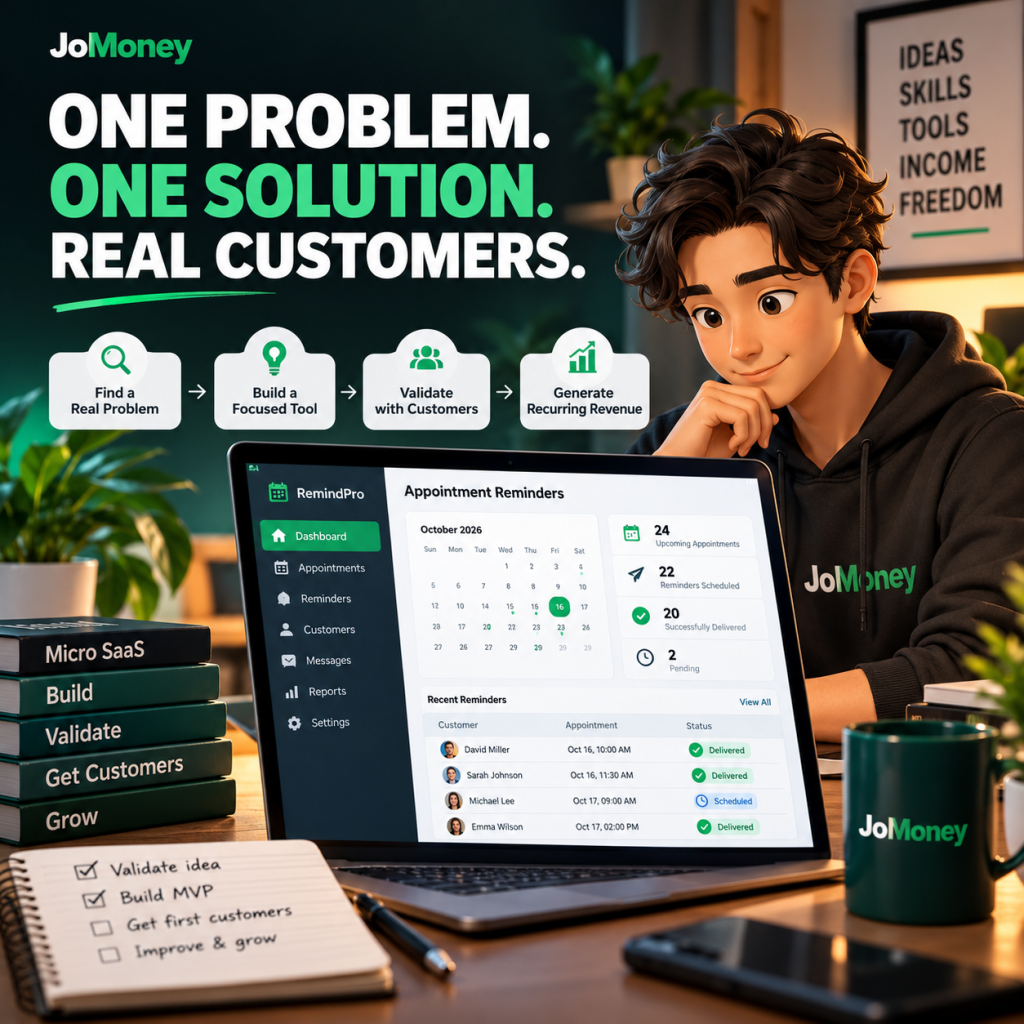
Building a software business doesn’t have to begin with an ambitious startup idea. Sometimes, the best opportunity is a frustrating task that a small group of customers would gladly pay to eliminate.
A repair shop owner checks tomorrow’s appointment schedule before closing for the day. There are twelve bookings. Three customers have a history of forgetting their appointments, so the owner spends another fifteen minutes sending reminders.
It isn’t particularly difficult work. That’s partly why it keeps getting postponed.
Now imagine someone offers the owner a simple online tool that sends those reminders automatically. No complicated booking system. No expensive software package with fifty features. Just a reliable way to make sure customers remember their appointments.
Would the owner pay $15 a month for it?
Maybe.
That single word is where an interesting software idea becomes a business question.
The opportunity isn’t simply to automate appointment reminders. It’s to discover whether enough businesses have the problem, whether existing solutions are inadequate, and whether the proposed tool delivers enough value to justify its price.
This is the foundation of what we’ll call the one-problem business: a small software product designed to solve one clearly defined problem for a specific group of customers.
It’s also a practical way to approach building a micro-SaaS business without immediately committing months of development time or a large startup budget.
1. What Is a One-Problem Business?
A one-problem business is built around a narrow promise.
Instead of trying to manage every aspect of a customer’s business, the software concentrates on one recurring frustration and solves it exceptionally well.
Consider the difference between two products.
The first is a comprehensive business management platform with invoicing, employee scheduling, customer management, accounting, marketing automation, and reporting.
The second automatically generates a weekly sales report for small online stores and sends it to the owner’s email.
Both could be useful. But they represent very different business opportunities.
The comprehensive platform requires extensive development, integrations, maintenance, and customer support. It also competes with established software providers.
The reporting tool has a narrower purpose. Its success depends on whether store owners actually need that specific report and consider it worth paying for.
How This Relates to Micro-SaaS
Micro-SaaS generally describes a small, focused software-as-a-service business, often operated by an individual founder or a small team.
Customers typically access the software online and pay through a recurring subscription.
Examples might include:
- A reporting tool for independent e-commerce stores.
- An automated reminder system for service businesses.
- A client approval portal for freelance designers.
- A subscription renewal tracker for small organizations.
- A specialized inventory alert system for niche retailers.
The attraction is not that these businesses are effortless.
It’s that a focused product may require fewer resources than a broad software platform.
The trade-off is equally important: a narrow market can limit growth, and customers may eventually find the same functionality inside software they already use.
The goal is to find a problem that is small enough to solve but important enough that customers will pay for the solution.
2. Why Small Problems Can Become Business Opportunities
Business owners don’t necessarily wake up wanting new software.
They want fewer missed appointments, fewer administrative mistakes, faster reporting, and more time for work that generates revenue.
Software becomes attractive when it improves one of those outcomes.
Imagine a freelance designer who spends two hours every Friday organizing client feedback scattered across email, messaging apps, and shared documents.
A simple approval portal could reduce that administrative work.
But the time saved alone doesn’t prove that the designer will purchase the product.
Perhaps the designer already uses a project management platform. Perhaps clients refuse to log in to another application. Or perhaps the inconvenience is annoying but not significant enough to justify another monthly subscription.
This distinction matters.
A problem becomes a stronger business opportunity when it has four characteristics.
Frequency: The problem occurs regularly rather than once or twice a year.
Consequences: The problem costs time, money, customers, or operational reliability.
Inadequate alternatives: Existing solutions are expensive, complicated, unreliable, or poorly suited to the customer’s workflow.
Willingness to pay: Customers consider solving the problem valuable enough to spend money.
A recurring inconvenience isn’t automatically a business opportunity.
But a recurring inconvenience with measurable consequences and dissatisfied customers deserves investigation.
3. How to Find a Problem Worth Solving
The search for a software business idea often begins in the wrong place.
People brainstorm applications they would enjoy building.
A better starting point is examining work that people already do.
Look for repeated activities involving spreadsheets, copied information, manual reminders, email attachments, or data transferred between applications.
These activities sometimes reveal gaps between what existing software provides and what businesses actually need.
Start With Industries You Understand
If you work with WordPress and WooCommerce, you might notice that smaller store owners struggle with understanding failed payments, monitoring abandoned checkouts, or preparing specialized reports.
If you work with service businesses, you might notice appointment scheduling problems or repetitive customer communication.
If you work with freelancers, you might encounter difficulties collecting project approvals or tracking deliverables.
Familiarity gives you an advantage because you understand the workflow and can recognize when a proposed solution would create more complications than it removes.
Look for Workarounds
One useful question is:
What are people repeatedly doing manually because their existing software doesn’t handle it properly?
A spreadsheet isn’t necessarily evidence of a business opportunity. Sometimes a spreadsheet is the best solution.
But when a business repeatedly exports data, rearranges columns, checks for errors, and emails the result to several people, there may be an opportunity to automate that workflow.
The next step is to understand why the business hasn’t already automated it.
Perhaps existing tools are too expensive. Perhaps the task requires unusual rules. Perhaps the business simply doesn’t know a suitable solution exists.
Each explanation leads to a different business decision.
4. Validate the Problem Before Building Anything
Developers often underestimate how easy it is to become attached to a product idea.
Once you’ve designed an interface and started writing code, abandoning the project becomes emotionally difficult.
That’s why customer research should happen before serious development.
Start by speaking with people who experience the problem.
Don’t begin by demonstrating your proposed application. First, understand how they currently work.
Five Questions Worth Asking Potential Customers
- Can you walk me through the last time you encountered this problem? This encourages a concrete account rather than a hypothetical opinion.
- How do you currently handle it? Existing workflows reveal alternatives and hidden requirements.
- What happens when the problem isn’t resolved? The answer helps establish the consequences.
- Have you tried paying for a solution? What happened? Previous purchasing behavior can reveal genuine demand.
- Who decides whether your business purchases software, and what would justify that expense? The person experiencing the problem may not control the budget.
Avoid asking only, “Would you use an application that does this?”
People frequently express interest in hypothetical products without intending to purchase them.
A stronger signal might be someone agreeing to a paid pilot, requesting a formal proposal, or making a clearly documented purchasing commitment.
Even then, interest isn’t guaranteed future revenue.
Validate the Market, Not Just the Idea
Suppose eight business owners describe the same frustration.
That’s useful information, but it doesn’t establish a market.
You still need to investigate how many similar businesses exist, how they purchase software, what alternatives they use, and how much it costs to reach them.
A product serving a small niche can succeed, but the numbers must make sense.
A market containing only a few hundred potential customers may be perfectly adequate for a small independent software business.
It may also be too small if the product requires expensive infrastructure, extensive support, or specialized compliance.
The economics matter more than the excitement surrounding the idea.
5. A Practical Example: The Appointment Reminder Tool
Let’s develop a hypothetical business from the beginning.
This is an illustrative case study, not an account of an actual company or verified customer research.
The Initial Observation
An aspiring founder notices that several independent service businesses manually remind customers about appointments.
The founder considers building a lightweight reminder application.
At first, the target audience includes salons, repair shops, tutors, and consultants.
That sounds like a reasonably large market.
But further investigation could reveal an immediate problem.
Many businesses already use booking platforms with built-in reminders.
Competing with those platforms by offering the same feature may be difficult.
The founder therefore needs to identify a more specific customer segment.
Narrowing the Target Customer
Imagine the founder discovers that certain independent repair workshops manage appointments using spreadsheets rather than specialized booking software.
These businesses may not want to replace their existing scheduling process.
They simply want reminders sent automatically.
That suggests a narrower product:
An appointment reminder tool for small repair workshops that already manage bookings in spreadsheets.
The proposed workflow becomes straightforward.
A workshop uploads its appointment schedule. The application identifies upcoming bookings, schedules reminders, and records whether each reminder was successfully delivered.
The owner doesn’t need to adopt an entirely new business management system.
Testing Whether the Product Is Necessary
Before developing the application, the founder should investigate several questions.
Can workshops already achieve this using inexpensive automation tools?
Do customers consent to receiving reminders?
Which communication channels are appropriate?
How frequently do appointments change?
Would workshop owners trust a new provider with customer contact information?
How many missed appointments could realistically be prevented?
The answers may reveal that the idea is commercially weak.
Alternatively, they may identify a narrow but underserved group of customers.
Both outcomes are valuable.
Finding out that a product isn’t worth building can save considerable time and money.
6. The P.A.I.D. Problem Test
To make idea evaluation more systematic, consider a simple framework called the P.A.I.D. Problem Test.
It evaluates four aspects of a potential software business.
| Factor | Key Question | Score |
|---|---|---|
| Pain | How serious and frequent is the problem? | 1–5 |
| Alternatives | How poorly do existing solutions address it? | 1–5 |
| Impact | How much measurable value could a solution deliver? | 1–5 |
| Demand | What evidence exists that customers will pay? | 1–5 |
| Total | 20 maximum |
For the Alternatives category, a higher score means existing solutions are less satisfactory.
This is an editorial decision-making worksheet, not a scientifically validated method for predicting startup success.
P: Pain
A minor inconvenience might receive a low score.
A recurring problem that causes lost revenue or serious administrative delays could receive a higher score.
A: Alternatives
Research existing software carefully.
If customers already have access to a reliable, inexpensive solution, the opportunity may be limited.
A high score requires evidence that current alternatives fail to meet an important need.
I: Impact
Estimate the potential benefit.
Could the software save five hours of work per month?
Could it reduce manual errors?
Could it improve the reliability of a critical workflow?
Avoid assuming that every minute saved translates directly into additional revenue.
D: Demand
This is arguably the most important category.
Compliments and expressions of interest are weak evidence.
Paid trials, purchasing commitments, and repeatable customer acquisition provide stronger evidence.
A high total score suggests that further investigation may be worthwhile. It does not guarantee a profitable product.
7. Build the Smallest Product That Delivers Value
Once you’ve gathered credible evidence of demand, the next challenge is deciding what to build.
This is where many software projects become unnecessarily complicated.
A founder begins with appointment reminders.
Then comes a calendar, customer management system, payment gateway, employee scheduling module, analytics dashboard, and marketing automation feature.
Eventually, the original problem becomes a small component of a much larger application.
A minimum viable product, or MVP, should test the essential value proposition with as little unnecessary complexity as practical.
For our hypothetical reminder application:
| Feature | MVP Priority | Reason |
|---|---|---|
| Secure business login | Essential | Protects account access |
| Appointment CSV import | Essential | Supports existing workflows |
| Automated reminder scheduling | Essential | Delivers the core benefit |
| Reminder delivery status | Essential | Helps identify failures |
| Basic appointment management | Essential | Allows corrections |
| Advanced analytics | Later | Not required to test demand |
| Full booking calendar | Later | Expands beyond the original problem |
| Employee scheduling | Exclude initially | Solves a different problem |
| Marketing campaigns | Exclude initially | Adds complexity without validating the core use case |
Even a focused MVP needs appropriate security, privacy controls, error handling, and reliability.
“Minimum” should describe the feature set, not the quality of essential safeguards.
Test the Workflow Before Automating Everything
A useful alternative is a manually assisted pilot.
For example, the founder could help a few businesses prepare reminder schedules using existing tools, with their permission and appropriate data protection.
This approach can reveal operational complications before investing in custom software.
The objective is to learn whether customers value the outcome.
If they don’t, adding more features probably won’t solve the underlying problem.
8. Choosing How to Build Your Software
Once you’ve identified the essential features, you need to decide how to develop the product.
There isn’t one correct approach.
The right technology depends on your experience, budget, security requirements, integration needs, and long-term maintenance plans.
Traditional Custom Development
A custom application gives you considerable control over its architecture and functionality.
You can design the database, user interface, APIs, and business logic around your product’s specific requirements.
This flexibility comes with responsibility.
You’ll need to manage authentication, authorization, infrastructure, security updates, backups, testing, and application monitoring.
Custom development makes sense when the product has requirements that existing platforms cannot accommodate efficiently.
WordPress-Based Development
WordPress can provide a practical foundation for certain software products, especially those involving content management, membership functionality, e-commerce, or familiar administrative workflows.
For example, a specialized reporting service for WooCommerce stores might use a custom WordPress plugin.
This approach can reduce the amount of infrastructure you need to develop from scratch.
However, WordPress isn’t automatically the best platform for every SaaS application.
Products requiring complex real-time processing, unusual data models, or extensive background workloads may benefit from a different architecture.
WordPress also requires careful attention to plugin compatibility, updates, permissions, and performance.
Low-Code Development
Low-code platforms can help entrepreneurs create prototypes and simple applications without writing every component manually.
They may be useful for testing workflows, building dashboards, or connecting existing services.
However, founders should investigate platform limitations, pricing changes, data portability, and vendor dependency.
A prototype that is inexpensive to operate with five users may become costly or restrictive as usage increases.
AI-Assisted Development
AI tools can accelerate parts of software development.
They can help transform rough requirements into structured specifications, suggest database designs, generate initial code, prepare tests, and explain unfamiliar technical concepts.
For a small software business, this can reduce the time required to explore ideas.
But AI-generated code isn’t automatically production-ready.
A generated application may appear functional while containing authorization vulnerabilities, insecure data handling, incorrect payment logic, or unreliable background processing.
These problems become particularly serious when customers trust the software with business information.
AI can help you build software faster. It cannot determine whether customers need that software, and it cannot replace proper security and quality assurance.
A responsible development process includes code review, automated testing, access-control verification, backup and recovery planning, and monitoring.
Payment processing should generally rely on established providers rather than custom handling of sensitive card information.
The important decision is not whether to use AI.
It’s how to use it without compromising the reliability of the product customers will depend on.
9. How Much Does a Small SaaS Business Cost?
One of the most appealing aspects of a focused software product is the possibility of starting with relatively modest infrastructure.
However, inexpensive hosting doesn’t mean the entire business is inexpensive.
Consider a hypothetical micro-SaaS charging $15 per customer per month.
Its monthly revenue would look like this:
| Paying Customers | Monthly Revenue | Annualized Revenue |
|---|---|---|
| 10 | $150 | $1,800 |
| 25 | $375 | $4,500 |
| 50 | $750 | $9,000 |
| 100 | $1,500 | $18,000 |
| 200 | $3,000 | $36,000 |
These figures assume every customer pays the full subscription price for the relevant period.
They do not account for cancellations, refunds, discounts, failed payments, or operating expenses.
The annualized column represents monthly revenue multiplied by twelve, not a forecast of actual annual sales.
Revenue Is Not Profit
Suppose our hypothetical appointment reminder business has 50 paying customers.
Monthly revenue is $750.
Now consider this illustrative operating budget:
| Expense | Estimated Monthly Cost |
|---|---|
| Hosting and infrastructure | $35 |
| Domain and basic services | $5 |
| Messaging and email services | $90 |
| Monitoring and backups | $20 |
| Software subscriptions | $25 |
| Marketing | $75 |
| Payment processing | $45 |
| Total | $295 |
The business would have approximately $455 remaining before taxes, owner compensation, and other unlisted expenses.
These are invented planning assumptions, not current vendor quotations. Actual messaging and payment costs can vary substantially by country, provider, message volume, and customer behavior.
The model also excludes the value of the founder’s time.
If the founder spends twenty hours a month providing support, fixing bugs, and maintaining the application, that work has an economic cost.
A Simple Break-Even Calculation
Assume the business has:
- $200 in monthly fixed expenses.
- $1.90 in variable expenses per paying customer.
- A $15 monthly subscription price.
Each customer contributes $13.10 toward fixed expenses before taxes and owner compensation.
The calculation is:
$200 ÷ ($15 − $1.90) = 15.27 customers
Under these assumptions, the business needs at least 16 paying customers to cover its modeled monthly operating expenses.
That doesn’t mean the founder has earned a salary.
If the founder also wants to allocate $1,000 per month for their own work, the modeled requirement becomes:
($200 + $1,000) ÷ $13.10 = 91.60 customers
That means approximately 92 paying customers would be needed to cover those combined assumptions.
This is why a product generating several hundred dollars in monthly revenue may still be economically unattractive.
The Hidden Cost of Customer Churn
Recurring revenue is valuable because customers can continue paying over time.
But subscriptions also create an ongoing obligation to deliver value.
Suppose a product begins the month with 100 customers and loses five of them.
Its monthly customer churn rate is 5%, before considering new customers.
If the business cannot replace departing customers, revenue declines.
Customer retention therefore deserves as much attention as customer acquisition.
A small product with loyal customers may be more sustainable than a larger product that constantly struggles to replace subscribers.
10. How to Price a Tool People Will Actually Pay For
Pricing is one of the most difficult decisions for a new software founder.
Charge too much, and prospective customers may choose alternatives.
Charge too little, and the business may struggle to cover support and infrastructure costs.
The solution isn’t necessarily to become the cheapest option.
It’s to understand the economic value of the problem being solved.
Price Against the Value Delivered
Imagine a workshop owner spends two hours each month sending appointment reminders.
If the proposed application eliminates most of that work, the owner may consider a $15 subscription reasonable.
But the calculation depends on more than time.
The owner may value reliability, convenience, and reduced administrative interruptions.
Conversely, if the workshop already uses free reminder functionality, even $5 per month may be difficult to justify.
Price should reflect the customer’s alternatives and perceived value, not simply the number of features in the application.
Monthly Subscriptions
Monthly billing reduces the initial commitment for customers.
It can be appropriate when the software delivers continuing value.
However, customers can cancel when they no longer need the service, and the founder must maintain the application continuously.
Annual Subscriptions
Annual billing can improve cash flow and reduce payment administration.
Some businesses offer a discount in exchange for an annual commitment.
But prepaid subscriptions also create obligations to provide service throughout the paid period.
Annual revenue collected upfront should not be confused with money available to spend without considering future costs.
One-Time Payments
A one-time license can work for certain downloadable tools or software products.
However, ongoing hosting, messaging, and support expenses can make lifetime access difficult to sustain.
For products with recurring infrastructure costs, recurring pricing often aligns more closely with the service being delivered.
Test Pricing Before Committing
Rather than selecting a price based entirely on competitors, test it with prospective customers.
Ask what alternatives they currently purchase and what results would justify switching.
When appropriate, offer a limited paid pilot with clearly defined features and terms.
Actual purchasing decisions provide more useful information than hypothetical willingness-to-pay surveys.
11. Finding Your First 10 Paying Customers
Building the software may feel like the hardest part of starting a SaaS business.
For many founders, finding customers proves more difficult.
A functional application doesn’t automatically attract visitors, earn trust, or generate sales.
The first ten customers are particularly important because they can reveal whether the product delivers value outside the founder’s assumptions.
Begin With the People You Interviewed
If you conducted customer interviews during validation, some participants may be interested in testing the finished product.
These conversations are often more productive than approaching strangers because you already understand their problems.
However, research participation doesn’t create an obligation to purchase.
Approach potential customers respectfully and explain what has changed since the initial discussion.
Focus on a Specific Audience
Consider two marketing messages.
The first says:
“Our software helps businesses become more productive.”
The second says:
“Automatically send appointment reminders from your existing workshop spreadsheet.”
The second communicates a clearer use case.
A focused product benefits from equally focused marketing.
You don’t necessarily need thousands of website visitors.
You need to reach people who recognize the problem and are willing to evaluate your solution.
Use Educational Content
Useful articles can help prospective customers discover a product while researching a problem.
For our appointment reminder example, relevant topics might include reducing missed appointments, organizing workshop schedules, or choosing communication methods for customer reminders.
The articles should provide genuine advice, including situations where the product isn’t necessary.
Educational content can support long-term discovery, but search traffic is uncertain and usually takes time to develop.
Build Relationships, Not Spam Campaigns
Relevant industry associations, niche communities, professional groups, and complementary service providers may offer opportunities to meet prospective customers.
Participation should begin with understanding the community.
Repeatedly posting promotional links rarely establishes credibility.
A better approach is to contribute useful information, answer legitimate questions, and introduce the product when it directly addresses an expressed need and community rules permit it.
Track the Customer Acquisition Process
Keep a simple record of:
- Prospective customers contacted.
- Meaningful conversations.
- Product demonstrations.
- Trial activations.
- Paid conversions.
- Reasons customers decline.
- Reasons customers cancel.
These observations help identify whether the main obstacle is awareness, pricing, product fit, usability, or trust.
Don’t assume that every rejection means the product needs another feature.
Sometimes the problem is the target audience.
Sometimes the value proposition is unclear.
And sometimes the market simply isn’t attractive enough.
12. What Happens After Your First Customer Pays?
The first successful payment is an important milestone.
It’s also the beginning of a new set of responsibilities.
A paying customer expects the software to work consistently.
If the application sends appointment reminders, those reminders must be scheduled accurately.
If an import fails, the customer needs to know.
If the service becomes unavailable, the founder needs a recovery process.
Reliability Becomes Part of the Product
For a reminder system, reliability may require background job monitoring, retry policies, delivery status tracking, and alerts for failed tasks.
The founder must also account for time zones, daylight saving changes, duplicate imports, canceled appointments, and messaging provider failures.
These details may not appear in a product demonstration.
But they determine whether customers trust the software.
Security and Privacy Matter From the Beginning
Even a small application may store customer names, contact details, and appointment information.
The business needs appropriate access controls, secure storage, data retention policies, and procedures for handling personal information.
Applicable privacy and communications requirements depend on the markets served.
For example, sending automated messages may require consent, appropriate disclosures, and compliance with local communications rules.
These requirements should be investigated before launch.
Customer Support Is Product Research
Support requests aren’t merely interruptions.
They can reveal confusing interfaces, missing explanations, unreliable workflows, and unexpected customer needs.
However, not every feature request deserves implementation.
If one customer requests a complete accounting module, that doesn’t necessarily mean the reminder application should become an accounting platform.
A focused founder needs to distinguish improvements to the core product from requests that fundamentally change its purpose.
Retention Is Evidence of Continuing Value
A customer who pays once has demonstrated initial interest.
A customer who continues using the product over several months provides stronger evidence that it delivers ongoing value.
Track whether customers actively use the essential functionality.
If subscribers rarely log in or repeatedly encounter failures, future cancellations may follow.
A healthy micro-SaaS business depends on more than collecting subscription payments.
It depends on earning renewals.
13. Why One-Problem Businesses Fail
The one-problem approach can reduce unnecessary complexity, but it doesn’t eliminate business risk.
Several common problems can undermine an otherwise promising product.
The Problem Isn’t Important Enough
Customers may acknowledge that a task is frustrating without considering it worth paying to eliminate.
The lesson is to investigate consequences, not merely complaints.
Existing Solutions Are Already Good Enough
A specialized product may compete against a feature included in a larger platform.
Customers might prefer the convenience of keeping their existing software, even if your application performs one task better.
The lesson is to research alternatives before development.
The Founder Builds Too Much
Adding features increases development time, testing requirements, support obligations, and maintenance costs.
It can also make the product harder to understand.
The lesson is to expand only when customer evidence justifies the investment.
Customer Acquisition Is Too Expensive
A $15 monthly subscription may not support expensive advertising or lengthy sales processes.
If acquiring each customer costs more than the business can reasonably recover, growth can make the financial situation worse.
The lesson is to evaluate customer acquisition costs alongside pricing and retention.
The Product Depends Too Heavily on Another Platform
A SaaS product may rely on external APIs, messaging services, payment providers, or software ecosystems.
Changes to pricing, permissions, or technical requirements can disrupt operations.
The lesson is to identify dependencies early and prepare reasonable alternatives.
The Founder Underestimates Maintenance
Software needs updates, monitoring, security reviews, and support.
A product that generates modest recurring revenue but requires constant attention may not meet the founder’s financial or lifestyle goals.
The lesson is to measure the cost of operating the business, not just the cost of building it.
14. A Practical 30-Day Plan to Test Your First Software Business Idea
You don’t need to spend the next month building an application.
A more useful objective is to determine whether an idea deserves further investment.
The following schedule is a practical validation exercise, not a promise that a profitable product can be launched in thirty days.
| Period | Main Objective | Practical Activities |
|---|---|---|
| Days 1–7 | Identify a problem | Observe workflows, research alternatives, and define a target customer |
| Days 8–14 | Investigate demand | Interview prospective customers and examine purchasing behavior |
| Days 15–21 | Define the solution | Prepare a product specification, prototype, and preliminary financial model |
| Days 22–30 | Test the concept | Demonstrate the prototype, request feedback, and evaluate paid pilot opportunities |
Week 1: Investigate Before Inventing
Choose an industry you understand or can access.
Identify three recurring problems and research how businesses currently address them.
Use the P.A.I.D. Problem Test to compare opportunities.
Select one problem for deeper investigation.
Week 2: Speak With Potential Customers
Aim to conduct several meaningful conversations with people who experience the problem.
The goal isn’t to persuade them that your idea is brilliant.
It’s to understand their existing workflow, frustrations, alternatives, and purchasing process.
Look for patterns rather than relying on one enthusiastic response.
Week 3: Define a Focused Solution
Prepare a simple product specification.
Describe the target customer, the problem, the essential workflow, and the expected benefit.
Create a prototype if it will help customers evaluate the proposed solution.
Estimate operating costs and consider what price would be necessary to sustain the business.
Week 4: Test and Decide
Show the proposed workflow to prospective customers.
Where appropriate, discuss a paid pilot with clear deliverables and terms.
Record objections and compare the feedback with your original assumptions.
At the end of the month, make one of three decisions:
Proceed: Evidence suggests that further development is justified.
Refine: The problem appears meaningful, but the proposed solution or target audience needs adjustment.
Stop: Demand is insufficient, alternatives are stronger than expected, or the economics are unattractive.
Stopping a weak project is not wasted effort.
It can prevent months of unnecessary development.
15. Frequently Asked Questions
Can I Start a Micro-SaaS Business Without Knowing How to Code?
Yes, it is possible to validate an idea and create certain prototypes using low-code platforms or AI-assisted development tools.
However, operating commercial software requires technical responsibility. If you cannot evaluate security, reliability, and data protection, consider working with a qualified developer before launching a production service.
How Much Money Do I Need to Start a Micro-SaaS Business?
There is no universal minimum.
A simple prototype may require relatively little spending, especially if you already have development skills.
A production application can involve hosting, payment processing, messaging, security, legal compliance, marketing, and ongoing maintenance.
Estimate costs for your specific product rather than relying on generic startup budgets.
Is Micro-SaaS Passive Income?
Generally, no.
Subscriptions can generate recurring revenue, but the business still requires maintenance, customer support, monitoring, and improvements.
Some products become relatively efficient to operate over time, but that outcome isn’t guaranteed.
What Is the Best Micro-SaaS Idea for Beginners?
A promising starting point is a recurring problem in an industry you understand.
Look for workflows where customers experience measurable inconvenience and existing solutions are inadequate.
The best idea is not necessarily the most technically impressive one. It is the one supported by credible customer demand and workable economics.
How Long Does It Take to Build a Profitable Micro-SaaS Business?
There is no reliable universal timeline.
Some products can be prototyped quickly, while others require substantial development, integration, and compliance work.
Profitability depends on customer acquisition, pricing, retention, operating costs, and the founder’s time investment.
A thirty-day validation process can help you decide whether to proceed, but it cannot guarantee commercial success.
Conclusion: Start With a Problem, Not a Product
It’s easy to become excited about what modern software development tools make possible.
A single developer can now experiment with ideas, create prototypes, and automate workflows that once required much larger teams.
But easier development doesn’t automatically create stronger businesses.
Customers don’t purchase software because its founder used an impressive technology stack.
They purchase it because they believe it will help them accomplish something important.
The appointment reminder tool we’ve explored might become a viable business. It might also fail because existing alternatives are sufficient or customers aren’t willing to pay.
Neither outcome can be determined by writing more code.
The answer comes from understanding the customer, testing the proposed value, and examining the economics.
Before planning your next application, try something simpler.
Find one person performing a frustrating task. Understand why the task matters, what they’ve tried, and what a better outcome would be worth.
Then find out whether other people have the same problem.
A sustainable small software business doesn’t begin with a hundred features. It begins with one problem worth solving, for customers willing to pay for the solution.

Discussion